How Lighting Design Transforms Any Wedding Venue
The single most underestimated element in wedding design — and why couples who invest in lighting never regret it.
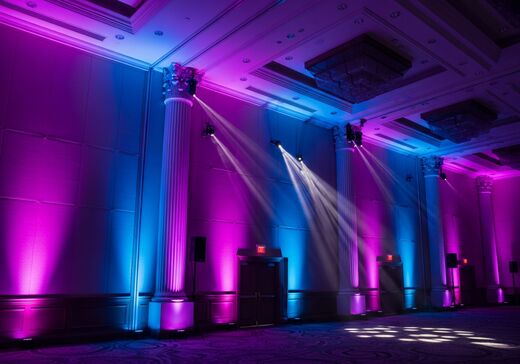
Lighting is the difference between a room and an experience.
Why Lighting Is the Most Impactful Design Investment
Ask any wedding photographer, planner, or venue coordinator what single element makes the biggest visual difference at a reception, and the answer is almost always the same: lighting. Not flowers. Not linens. Not centerpieces. Lighting. It's counterintuitive — couples will spend $15,000 on florals and $500 on lighting, when the inverse would create a more dramatic visual impact. Professional lighting transforms the geometry, mood, and emotional quality of any space. It can make a cavernous ballroom feel intimate, a simple tent feel magical, and a plain reception hall feel like a Parisian salon. It photographs beautifully, creates atmosphere that guests feel even if they can't articulate why, and fundamentally changes the energy of a room.
Uplighting: The Foundation
Uplighting — LED fixtures placed around the perimeter of a room, washing the walls in color — is the most accessible and immediately impactful form of wedding lighting. It eliminates the harsh, flat quality of venue house lighting and replaces it with dimensional warmth and color. Soft amber uplighting creates a warm, candlelit atmosphere. Deeper tones like rose gold or dusty blue add drama and sophistication. And because uplighting fixtures are wireless and battery-powered, they can be placed anywhere — including outdoor spaces, tented areas, and venues with limited electrical access. For couples working within a budget, uplighting alone transforms a reception space more dramatically than any other single investment.
Pin Spots and Table Lighting
Pin spots are narrow-beam lights focused directly on centerpieces, making them glow against a darker ambient background. The effect is stunning — centerpieces become sculptural focal points, and the room takes on the quality of a fine dining restaurant. Combined with candles and lowered house lights, pin-spotted tables create an atmosphere of intimacy and elegance that photographs beautifully and makes guests feel like they're in a truly special environment. Pin spots also allow you to simplify your centerpiece design — when flowers are professionally lit, simpler arrangements have just as much visual impact as elaborate ones.
Dance Floor and Production Lighting
The dance floor is where lighting becomes theatrical. Intelligent moving lights can create dynamic energy that builds with the music — subtle patterns during slower songs, dramatic sweeps and color changes during high-energy moments. A well-designed lighting rig over the dance floor turns it into a destination — guests are drawn to the energy and visual excitement of a lit dance floor in a way that a flat, fluorescent-lit space simply cannot achieve. Monograms, texture projections, and atmospheric effects like haze add additional layers of visual interest. The key is having a lighting designer who understands pacing — the lighting should follow the emotional arc of the evening, not just run on autopilot.
Working With Your Venue's Architecture
Great lighting design works with the venue, not against it. High ceilings call for upward-facing fixtures that emphasize vertical grandeur. Exposed brick or stone walls come alive with carefully placed wash lighting. Architectural details — columns, archways, ceiling beams — can be highlighted to create visual anchors throughout the space. Outdoor and tented weddings present unique opportunities: string lights, lanterns, and tree uplighting create enchanted environments that are impossible to replicate indoors. The best approach is always to start with what the venue gives you — its natural character, its strengths, its architectural language — and use lighting to amplify and refine those qualities.
Questions to Ask Your Lighting Team
When evaluating lighting providers, ask to see photos from your specific venue (or similar venues) — renders and stock photos don't tell the full story. Ask how many fixtures they'll use and where they'll place them. Ask about setup and strike times — will they need access hours before your event? Ask whether their team includes a lighting designer who'll be present during the event to make real-time adjustments, or whether they're simply dropping off fixtures. And ask how lighting integrates with the entertainment — the most seamless wedding experiences come from teams where sound, music, and lighting are coordinated by the same company, responding to the energy of the room as a unified production.
Ready to see what lighting can do for your venue? Let's design something stunning together.
Check Availability